


BPD meets ADHD - Two neurodiverse worlds united under one roof
Hello everyone ❤️
I'm not writing this post because our relationship is difficult, but because it's real. Kim and I have been together for 14 years. Our love is intense, deep, and has grown over time. We know we can rely on each other when things get tough. No matter how chaotic or overwhelming things get, we're there for each other. We usually make up quickly, and loyalty is something that's never in doubt between us.
At the same time, we live with two diagnoses that significantly shape our daily lives: borderline personality disorder and ADHD. This doesn't make our relationship worse – but it does make it more complex. And that's precisely what I want to write about: BPD meets ADHD.
Living with BPD in a relationship
To love with BPD means to love intensely. My feelings aren't quiet or in the background, but present, loud, and sometimes overwhelming. Closeness gives me security. Distance, withdrawal, or a change in tone of voice can quickly feel threatening, even if it's not meant that way.
My reactions are often impulsive. Words come out faster than I can process them. Feelings demand immediate release. Not because I'm looking for drama, but because my nervous system is sounding the alarm and trying to protect me.
Living with ADHD in a relationship
Kim's ADHD manifests very differently. His mind is constantly racing. Thoughts jump around, stimuli bombard him unfiltered, and he struggles to maintain his attention. Switching off, drifting off, or withdrawing is often a necessary form of self-protection for him.
What sometimes feels like being ignored to me is often, for him, overwhelm or hyperfocus. What I consider a clarifying conversation can simply be too much for him at the wrong moment.
Impulsivity – on both sides
A major common denominator between BPD and ADHD is impulsivity. However, it manifests itself differently.
For me, it's emotional. Feelings are immediate and very intense. For Kim, it's more mental and behavioral. Reactions, decisions, or words happen quickly, often without much thought.
Things get difficult when this impulsiveness triggers itself. If I react emotionally right away, he quickly feels overwhelmed or pressured. If he impulsively avoids, shuts down, or changes the subject, it deeply affects me and triggers old anxieties. Both reactions stem from feeling overwhelmed—not from a lack of love.
Many points of contact, more similarities than differences
What is often overlooked is that BPD and ADHD have many overlapping characteristics. These include a sensitive nervous system, difficulties with self-regulation, rapid sensory overload, strong stress reactions, and a high need for inner security.
We both know the feeling of being too much inside. We just deal with it differently. These commonalities connect us – they ensure that we understand each other very deeply at times. At the same time, they intensify conflicts when our coping strategies contradict each other.
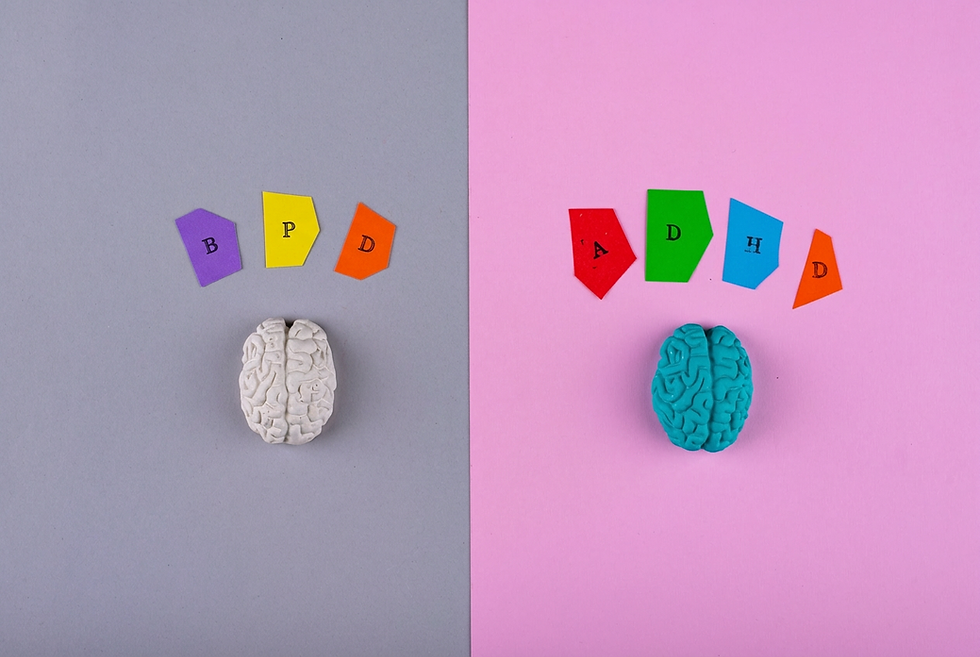
Contrasts in everyday life – when the same thing means relaxation or stress
In everyday life, our differences often become apparent in very simple situations. Things that are calming for one person can quickly become overwhelming for another.
Kim often feels more comfortable when there's a lot going on around him. Loud music, several noises at once, perhaps a conversation happening in the background – all of this can relax him. His nervous system receives exactly the stimulation it needs to avoid feeling restless or understimulated. Especially with his ADHD, these stimuli help him regulate himself.
For me, it's exactly the opposite. Too much noise, loud music, and simultaneous conversations quickly stress me out and overwhelm my nervous system. Everything comes through unfiltered; nothing can be blocked out. Instead of closeness or relaxation, inner tension arises—sometimes so intense that I'm barely responsive or even irritable.
These differences are also evident when they watch television together. Kim is often hyperfocused. Hyperfocus means that his attention is extremely focused on one thing, while everything else is blocked out. He is then completely absorbed in the film or series. In such moments, Kim is not intentionally absent or disinterested – his brain is simply fully attuned to a single stimulus.
If I approach him in this state and get no response, it quickly feels like I'm being ignored. This feeling sometimes makes me impatient or snappy—not because I want to attack him, but because old wounds are being reopened. For Kim, my reaction feels like an attack, because he's not intentionally ignoring me, but is simply unavailable at that moment.
This sometimes creates a dynamic in which we both react with hurt feelings, even though neither of us intends to harm the other. Two different kinds of feeling overwhelmed collide – and reinforce each other.
At the same time, I find it difficult to fully concentrate on the film. Even small distractions are enough to make me lose track. I take in a lot – but nothing properly.
For Kim, however, the exact opposite is possible. He can be on his phone or at the computer while watching TV and still follow the content. Multiple stimuli at once help his brain stay focused. What would be pure chaos for me is often just the right mix for him.
Another common thread in our daily lives is how we relax. Kim often needs active relaxation – for example, going into town, being around lots of people, discovering new things, and having social contact. His open, friendly nature makes such experiences enjoyable and invigorating for him.
For me, it's the opposite. Large crowds, noisy streets, and a lot of stimuli quickly drain my energy and overwhelm me—even when I'm meeting up with friends or family. I'm rather reserved and need peace and quiet because I'm often afraid of being judged or condemned. This doesn't mean I dislike people in general or am antisocial—it's simply about my nervous system and my energy levels.
Here too, we both want the same thing – a break from everyday life, relaxation, connection – but our paths to achieving it couldn't be more different. Only when we understood that this wasn't resistance or a lack of desire to be together, but simply different needs and neurodiversity, were we able to consciously shape such moments.
Despite all our differences, we always find our way back to each other. We talk about it, calm each other down, explain our perspectives – and usually reconnect more quickly than one might expect from the outside. Our connection carries us through even these moments.
Medication, monitoring, and what builds up.
Another difference lies in how the symptoms are managed. For ADHD, there are medications from the stimulant group that help many sufferers to focus, better filter stimuli, and function in everyday life – especially in their professional lives.
There is no single medication-based solution for borderline personality disorder. No pill that simply quiets emotions or makes inner tension disappear. Managing my symptoms largely involves therapy, skills training, self-reflection, and a lot of inner work – every single day.
What's often forgotten is that medication also means adjustment and control. If Kim has spent an entire workday highly focused, structured, and internally restrained, he comes home in the evening and lets go of that tension. Then, sometimes, what has been building up for hours comes to the surface.
In such moments, his tone might become sharper more quickly, or his patience might run short. Not because he wants to belittle me, but simply because his nervous system is exhausted and the medication's regulatory effect is diminishing.
This isn't always easy for me. It triggers old wounds and the feeling of not being seen or taken seriously. At the same time, this knowledge helps me not to take everything personally right away – even though my feelings are no less real because of it.

In conclusion - we are not against each other
What I want to show with this post is that we are not fighting against each other. We are both struggling with being overwhelmed, old patterns, and a nervous system that goes into alarm mode more quickly than many others.
Understanding doesn't mean accepting everything. But it helps to hurt each other less, to react more consciously, and to avoid constantly misinterpreting each other's behavior.
Our relationship isn't perfect. But it's built on understanding, trust, loyalty, and the certainty that we have each other – even when things are tough. And perhaps that's precisely the most important foundation when BPD and ADHD collide.
Thank you for taking the time to read this. I hope this text provided an honest insight and perhaps fostered a little understanding. Have a wonderful day. ❤️


Comments